After a couple of false starts the following article was published in Edition 8 of The West Dorset Magazine today. It’s a follow-up to an article I wrote for the magazine back in February which you can find here https://ecolelogical.com/2022/04/04/the-merciless-killing-of-our-birds-of-prey/
The latest article was originally due to be published in Edition 6 back in April but was held back by the editor. An updated version was then accepted for Edition 7 earlier this month but pulled by the editor at the last minute because of “technical issues” meaning she “hadn’t had time to chase Chris for his article and we need to run them together”. I subsequently confirmed she was referring to Chris Loder, MP for West Dorset, and queried whether he’d been made aware my article was due for publication, if he’d been shown the content in advance and asked why an article by him had to accompany it. After all, he’s had a right to reply since February and could submit his own article for publication whenever he wanted.
Although I didn’t get an answer to any of those questions, a slight re-draft of my original submission made it into Edition 8 which can be found on the magazine’s website today and which is copied below. The printed publication should be hitting doormats in West Dorset on Friday morning. As you can see, the piece is accompanied by a brief statement from the RSPB and an editorial confirmation that Mr. Loder has been offered a right to reply. I sincerely hope he chooses to clarify matters once and for all.
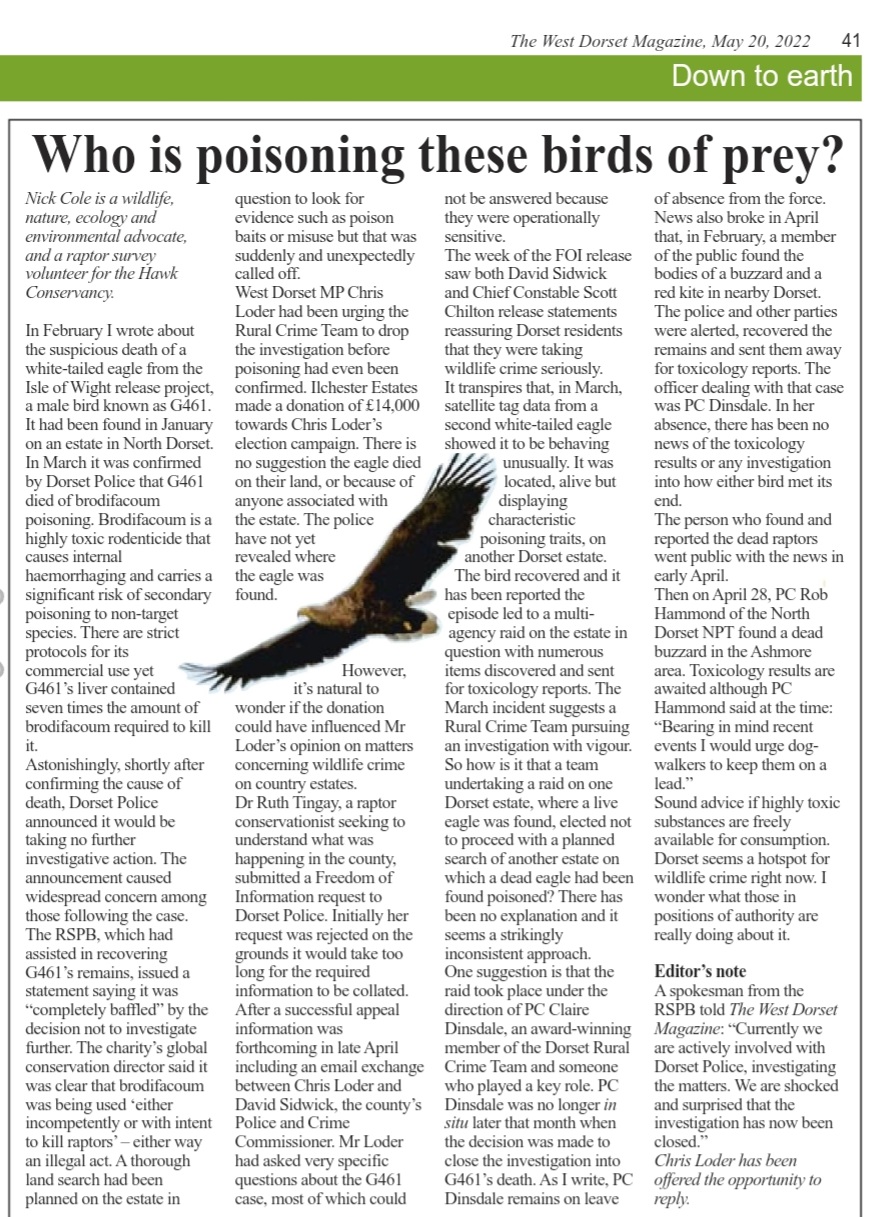
Here’s the piece in full. The original title of “Dorset’s dead raptors” was changed by the editor.
In February I wrote about the suspicious death of a white tailed eagle from the Isle of Wight release project, a male bird known as G461. It had been found in January on an estate in North Dorset.
In March it was confirmed by Dorset Police that G461 died of brodifacoum poisoning. Brodifacoum is a highly toxic rodenticide that causes internal haemorrhaging and carries a significant risk of secondary poisoning to “non-target” species. There are strict protocols for its commercial use yet G461’s liver contained 7 times the amount of brodifacoum required to kill it.
Astonishingly, shortly after confirming the cause of death, Dorset Police announced it would be taking no further investigative action. The announcement caused wide-spread concern among those following the case. The RSPB, which had assisted in recovering G461’s remains, issued a statement saying it was “completely baffled” by the decision not to investigate further. The charity’s Global Conservation Director said it was clear that brodifacoum “was being used either incompetently or with intent to kill raptors – either way an illegal act. A thorough land search had been planned on the estate in question to look for evidence such as poison baits or misuse but that was suddenly and unexpectedly called off”.
West Dorset MP Chris Loder had been urging the Rural Crime Team to drop the investigation before poisoning had even been confirmed. Ilchester Estates made a donation of £14,000 towards Chris Loder’s election campaign. There is no suggestion the eagle died on their land, or becaise of anyone associated with the estate. The police have not yet revealed where the eagle was found. However, it’s natural to wonder if the donation could have influenced Mr Loder’s opinion on matters concerning wildlife crime on country estates.
Dr Ruth Tingay, a raptor conservationist seeking to understand what was happening in the county, submitted a Freedom of Information request to Dorset Police. Initially her request was rejected on the grounds it would take too long for the required information to be collated. After a successful appeal information was forthcoming in late April including an email exchange between Chris Loder and David Sidwick, the county’s Police and Crime Commissioner. Mr. Loder had asked very specific questions about the G461 case, most of which could not be answered because they were “operationally sensitive”. The week of the FOI release saw both David Sidwick and Chief Constable Scott Chilton release statements reassuring Dorset residents that they were taking wildlife crime seriously.
It transpires that, in March, satellite tag data from a second white-tailed eagle showed it to be behaving unusually. It was located, alive but displaying characteristic poisoning traits, on another Dorset estate. The bird recovered and it has been reported the episode led to a multi-agency raid on the estate in question with numerous items discovered and sent for toxicology reports. The March incident suggests a Rural Crime Team pursuing an investigation with vigour. So how is it that a team undertaking a raid on one Dorset estate, where a live eagle was found, elected not to proceed with a planned search of another estate on which a dead eagle had been found poisoned? There has been no explanation and it seems a strikingly inconsistent approach.
One suggestion is that the raid took place under the direction of PC Claire Dinsdale, an award-winning member of the Dorset Rural Crime Team and someone who played a key role. PC Dinsdale was no longer in situ later that month when the decision was made to close the investigation into G461’s death. As I write, ahead of this article going to print, PC Dinsdale remains on leave of absence from the force.
News also broke in April that, in February, a member of the public found the bodies of a buzzard and a red kite in nearby Dorset. The police and other parties were alerted, recovered the remains and sent them away for toxicology reports. The officer dealing with that case was PC Dinsdale. In her absence, there has been no news of the toxicology results or any investigation into how either bird met its end. The person who found and reported the dead raptors went public with the news in early April. Then on 28th April, PC Rob Hammond of the North Dorset NPT found a dead buzzard in the Ashmore area. Toxicology results are awaited although PC Hammond said at the time: “Bearing in mind recent events I would urge dog-walkers to keep them on a lead”. Sound advice if highly toxic substances are freely available for consumption.
Dorset seems a hotspot for wildlife crime right now. I wonder what those in positions of authority are really doing about it.
Editor’s note– A spokesman from the RSPB told The West Dorset Magazine: “Currently we are actively involved with Dorset Police, investigating the matters. We are shocked and surprised that the investigation has now been closed”. Chris Loder has been offered the opportunity to reply.
It’s been brought to my attention by Ruth Tingay that Dorset Police has yet to respond to her FOI request or review. A partial response was received by her from the Dorset PCC although that office “forgot” to include some correspondence. This is also under appeal.
I’m grateful to Ruth for clearing that up.


Is there any end to this, our politicians seem hopelessly inadequate sometimes bordering on badness. Simple minded guy may think the gaming estate owner is responsible and the idiot who planted poison simply his lackey. Seems a battle is on between profit and nature, thank goodness there are many landowners who work alongside the interests of nature.
LikeLiked by 1 person
If the RSPB helped in the recovery of G461, why then do they continue to withhold the location? Go public.
LikeLike