This article was published in the 2nd edition of The West Dorset Magazine (25th February 2022)
A little over 2 years ago, wildlife charity The Roy Dennis Foundation, in partnership with Forestry England, began a White-tailed Eagle reintroduction project on the Isle of Wight. A total of 25 young eagles, all translocated from nests in Western Scotland, have now been released including 12 in 2021. Although the 2021 birds have yet to move away from the release site the 2019 and 2020 cohorts have spread their wings and had their movements monitored via satellite tracking and field observations. Dorset, its neighbouring counties and particularly Poole Harbour have been blessed with regular sightings of these magnificent birds and contributed to the information flow back to the Foundation.
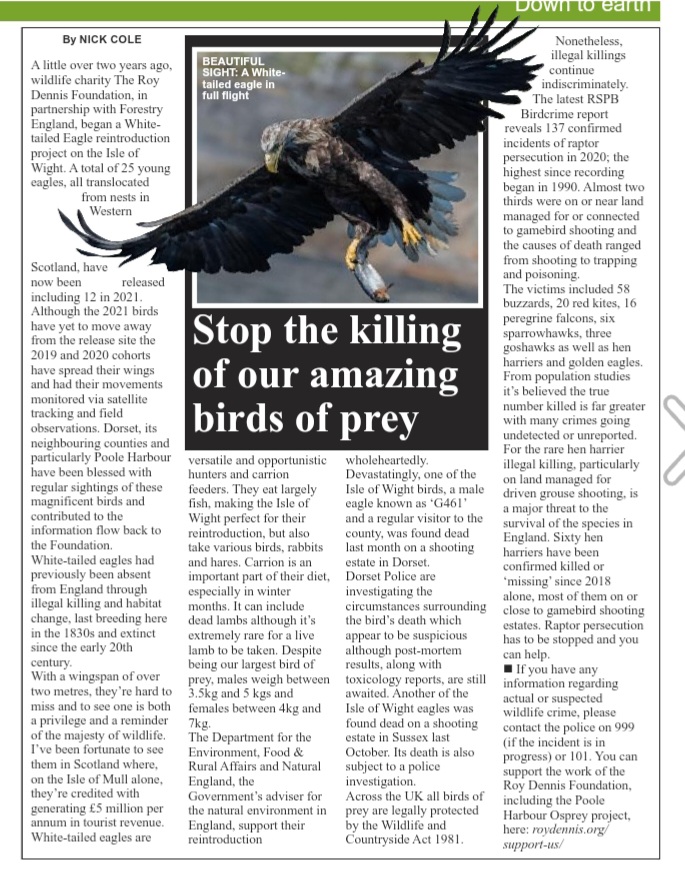
White-tailed Eagles had previously been absent from England through illegal killing and habitat change, last breeding here in the 1830’s and extinct since the early 20th century. With a wingspan of over 2 metres, they’re hard to miss and to see one is both a privilege and a reminder of the majesty of wildlife. I’ve been fortunate to see them in Scotland where, on the Isle of Mull alone, they’re credited with generating £5 million per annum in tourist revenue.
They’re versatile and opportunistic hunters and carrion feeders. They eat largely fish, making the Isle of Wight perfect for their reintroduction, but also take various birds, rabbits and hares. Carrion is an important part of their diet, especially in winter months. It can include dead lambs although it’s extremely rare for a live lamb to be taken. Despite being our largest bird of prey, males weigh between 3.5 and 5 kgs and females between 4 and 7 kg. The Department for the Environment, Food & Rural Affairs and Natural England, the Government’s adviser for the natural environment in England, support their reintroduction wholeheartedly.
Devastatingly, one of the Isle of Wight birds, a male eagle known as “G461” and a regular visitor to the county, was found dead last month on a shooting estate in Dorset. Dorset Police is investigating the circumstances surrounding the bird’s death which appear to be suspicious although post-mortem results, along with toxicology reports, are still awaited. Another of the Isle of Wight eagles was found dead on a shooting estate in Sussex last October. Its death is also subject to an ongoing police investigation.
Across the UK all birds of prey are legally protected by the Wildlife and Countryside Act 1981. Nonetheless, illegal killings continue indiscriminately. The latest RSPB “Birdcrime” report reveals 137 confirmed incidents of raptor persecution in 2020; the highest since recording began in 1990. Almost two thirds were on or near land managed for or connected to gamebird shooting and the causes of death ranged from shooting to trapping and poisoning. The victims included 58 buzzards, 20 red kites, 16 peregrine falcons, 6 sparrowhawks, 3 goshawks as well as hen harriers and golden eagles. From population studies it’s believed the true number killed is far greater with many crimes going undetected or unreported. For the rare hen harrier illegal killing, particularly on land managed for driven grouse shooting, is a major threat to the survival of the species in England. 60 hen harriers have been confirmed killed or “missing” since 2018 alone, most of them on or close to gamebird shooting estates.
Raptor persecution has to be stopped and you can help.
If you have any information regarding actual or suspected wildlife crime, please contact the police on 999 (if the incident is in progress) or 101. You can support the work of the Roy Dennis Foundation, including the Poole Harbour Osprey project, here: https://www.roydennis.org/support-us/


1 Comment