
Badger Trust’s excellent report “Tackling Bovine TB Together” was formally launched this morning. If you’ve any interest in the approach to eradicating this insidious disease in England then it’s a “must read”. It’s clear, meticulously researched and referenced and it blows the lid off the argument that badgers are a primary problem and that culling them in sickening numbers over the past 10 years has made a jot of difference to herd infections and farmer distress in England.
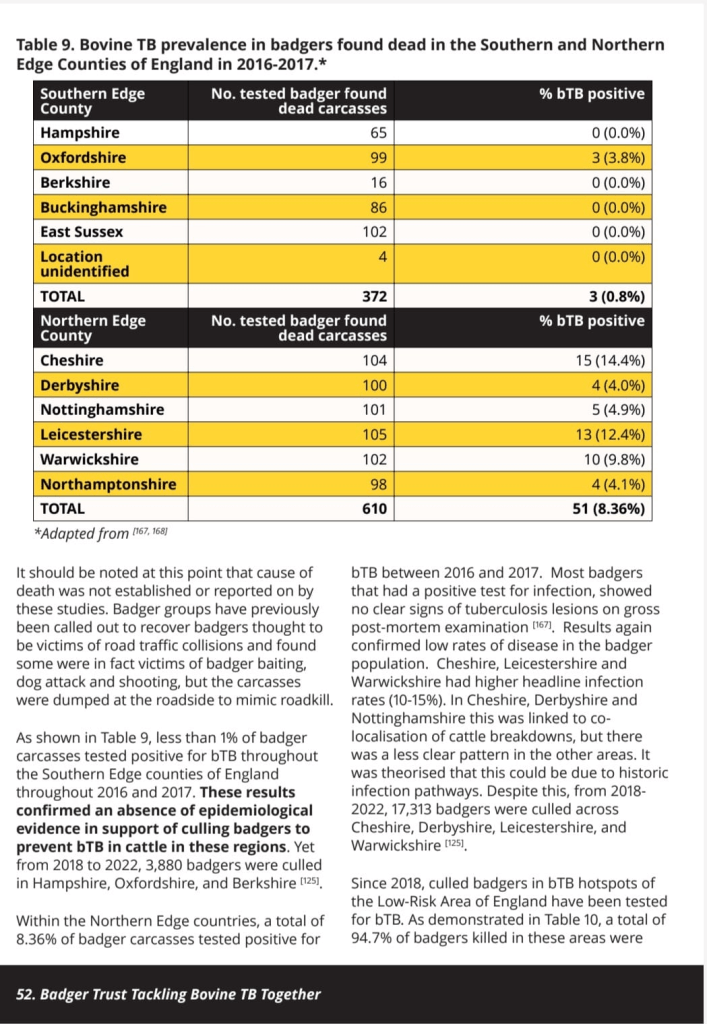
Page 52 of the report includes a table showing the results of a 2016/2017 study into the prevalence of bovine TB in badgers found dead in Hampshire. Of 65 carcasses tested, none were positive for bTB. Yes, you read that correctly, none. Zero. Zilch. 0.00%.
What the report doesn’t say (because the results are as yet unconfirmed and it’s a thoroughly professional document) is that there was a further study undertaken in Hampshire by the Animal Plant & Health Agency (APHA) between April 2021 and April 2023. The APHA tested a further 84 badger carcasses submitted from Hampshire between those dates. At the end of the project period, preliminary results indicated that bacteria from the same family as M. bovis had been found in 1 of those carcasses. Further tests were ongoing to establish whether the badger in question was infected with M. bovis itself and the official, peer-reviewed results of the APHA study are still awaited.
If the carcass in question was infected, it represents the only badger to have tested positive for bovine TB in the county out of 149 examined since 2016. That’s a 0.67% bTB prevalence. Or it could still be 0.00%. We won’t know until the APHA publishes its findings. Furthermore, a recent study in Northern Ireland identified that it’s 800 times more likely for a cow to infect a badger with bovine TB than the other way around. So there’s a fair chance that cows in Hampshire are posing a bovine TB threat to badgers and no confirmed evidence that the opposite is true.
As the Badger Trust report goes on to say, based on the 2016/17 study alone, “These results confirmed an absence of epidemiological evidence in support of culling badgers to prevent bTB in cattle in these regions”. And yet, Hampshire was included in the national badger cull for the first time in 2021 and culling has continued to this day.
1,346 of Hampshire’s badgers had been shot dead by cull contractors by the end of 2022. Between 621 and 1,240 more badgers were targeted for shooting here during 2023. We’ll find out the exact number killed in 2023 towards the end of March when Defra publishes the figures and makes its case for continuing the cull through 2024.
The UK Chief Veterinary Officer, Christine Middleton, has it in her power to bring an early close to the Hampshire cull with immediate effect – it’s currently not due to end until 2025. But will she? Last year she pronounced that she’d reviewed all the data available and concluded that an early termination of the Hampshire badger cull would be “sub-optimal”.
I wrote to her at the time, without reply, asking how that conclusion had been reached. I’ll be writing to her again shortly seeking an immediate end to the culling in Areas 56 and 67 (the two Hampshire cull zones) based on the continued absence of epidemiological evidence justifying the cruel slaughter of what is, after all, a protected species.
Feel free to write to her as well. And to your local MP. And to distribute this blog piece far and wide.

 ecolelogical