Regular readers will remember my correspondence late last year with local MP Ranil Jayawardena and Lord Richard Benyon, Minister for International Environment and the man responsible for the policy area in England which includes the badger cull and bovine tuberculosis. You can catch up here, here and here if you’d like to.
Since I’ve had no response at all from the Minister to the substantive points I’ve raised with him I wrote again to Ranil Jayawardena MP on 27th December. The email I sent is copied in full below. I’m tired of hearing how badgers are only being culled where the epidemiology justifies it. In Hampshire the epidemiology report for 2020 didn’t justify it yet the cull was introduced here the following year. We now know the epidemiology report for 2021 contained even less justification yet the cull target was increased by 115% in 2022. I want to know why. I’d like to understand who took that decision, who calculated the 2022 target number of 1,586 badgers and on what basis. And I want to know how Richard Benyon is fit for purpose in light of a clear conflict of interest here; our local cull director operating out of a farm on land owned by the Englefield Estate which is, in turn, owned by Richard Benyon.
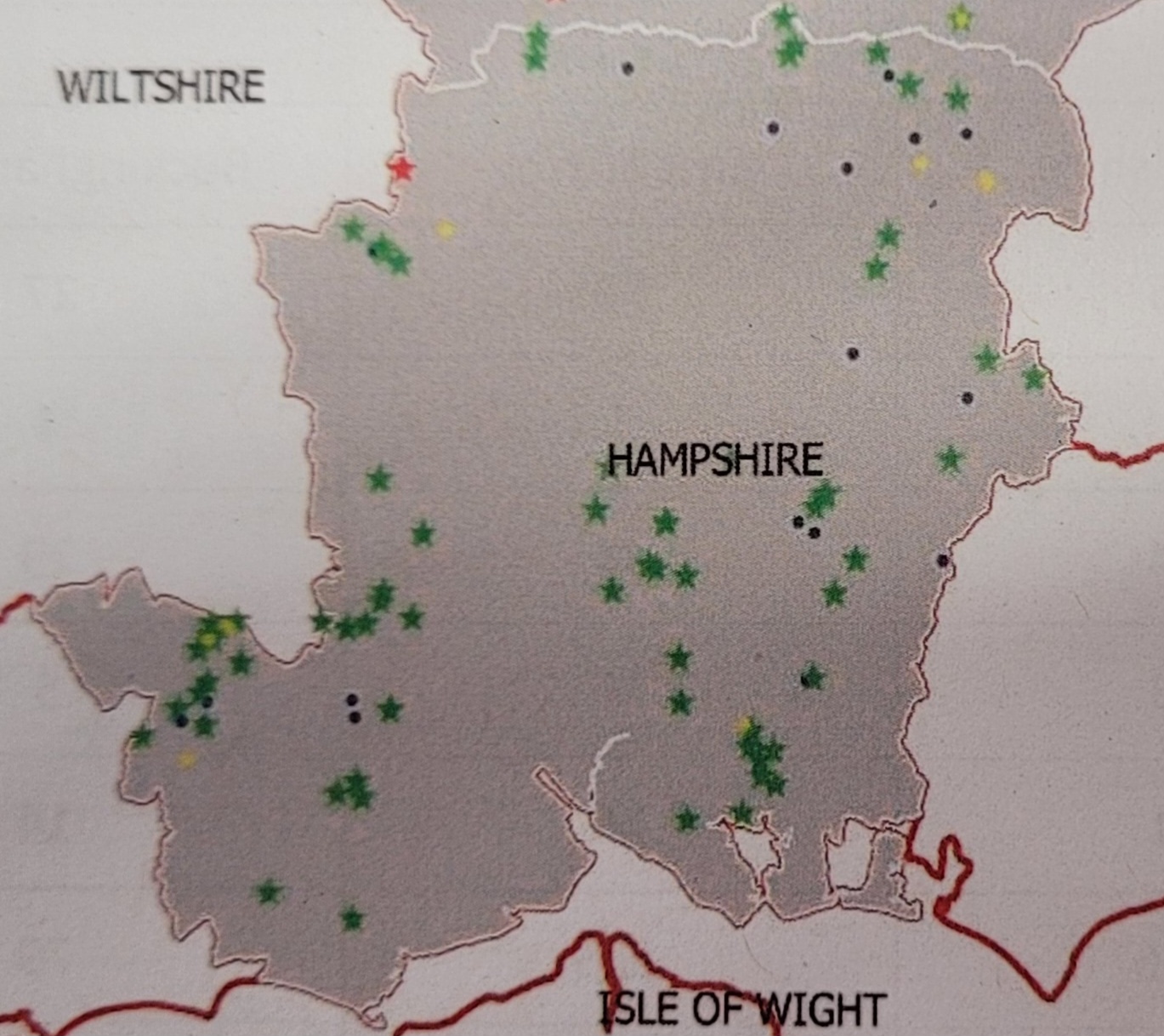
Since I sent the 27th December email to Mr Jaywardena it’s come to my attention that the APHA Southern Edge bTB project has still only identified 1 badger carcass testing positive for bTB out of 79 viable roadkill carcasses submitted to it from Hampshire between 6th April 2021 and 31st December 2022. As you can see from the image accompanying this piece, that carcass was found right on the Hampshire/Wiltshire border. It’s represented by the red asterisk on the map. Furthermore, for the first time, the December 2022 bulletin from the APHA now states “recent further analysis of samples that were initially shown as potentially positive for TB (found in the other Southern Edge counties of Oxfordshire, Buckinghamshire, Bedfordshire and East Sussex) indicate that several were in fact not the bacteria that causes bovine TB”.
The epidemiology justifying the Hampshire badger cull? One single badger found to have bTB in Hampshire in 2022. None in 2021. None in 2020. Yet 578 badgers were culled here in 2021 and 1,586 were targetted to be culled in 2022. We don’t yet know how many were actually killed last year.
The “key risks to bovine TB in Hampshire” identified by the APHA in both 2020 and 2021? Poor cattle biosecurity and herd management practices with “best practice” still only voluntary and not mandatory for farmers.
What staggers me as much as the appalling persecution of a “protected species” here in Hampshire is the apparent apathy of long-established wildlife groups such as the Hampshire & Isle of Wight Wildlife Trust of which, for now at least, I’m a member. It’s an organisation that’s happily appropriated an image of a badger for its logo but which has done little or nothing to challenge the badger cull in this county. That’s something I’m looking forward to addressing when I speak at the forthcoming “Hampshire Nature Forum” in March.
From: Nick Cole
Sent: 27 December 2022 15:22
To: Ranil Jayawardena MP <email@ranil.uk>
Subject: Hampshire Badger Cull
Dear Mr Jayawardena,
Thank you for your letter dated 1st December (Reference RJ36366-SW).
We both appear to still be awaiting a reply from Richard Benyon to the substantive points in my emailed letter of 27th September and to the points I raised in my letters to both of you dated 1st December. Since then, the APHA Year End Descriptive Epidemiology Report: Bovine TB in the Edge Area of England , County: Hampshire has been published by DEFRA. You can access the report here and I encourage you to read it as a matter of urgency.
Richard Benyon asserts twice in his letter to you of 21st November that “culling will only remain an option where an epidemiological assessment indicates it is required”. The clear scientific evidence produced by the APHA for both 2020 and 2021 shows this statement simply isn’t true.
- As you already know, the 2020 APHA Year End Descriptive Epidemiology Report for Hampshire identified bTB in one domestic cat in Southampton but none in badgers anywhere in the county. It cited risks to Hampshire in 2020 “continued to be movement of cattle with undetected infection from the High Risk Area (HRA) and Edge Area and movements within the country from six-monthly testing parishes to annual testing parishes”. Rather than introduce mandatory bTB herd management and biosecurity protocols, DEFRA included Hampshire in the badger cull for the first time in 2021 and 578 badgers were killed as a result.
- The APHA has confirmed under a FOI that none of the 578 badgers shot in Hampshire in 2020 tested positive for bTB.
- The APHA Year End report for 2021 identified no bTB found in badger populations anywhere in the county.
- The 2021 report states the two most significant drivers of the bTB epidemic in Hampshire were “the purchase of undetected infected cattle” and “residual infection from previous incidents”. Exposure to “probable” infected badgers was reckoned by the APHA to contribute to a maximum of 11% of infection sources in 2021. Cattle movements contributed to 47%. Residual cattle infection contributed to 19%. Rather than introduce mandatory bTB herd management and biosecurity protocols, DEFRA added a further badger cull zone in Hampshire in 2022 and increased the cull target by 115% to 1,586 badgers.
- The APHA has confirmed under a FOI that none of the badgers shot under the 2022 cull licensing regime will be tested for bTB.
- The APHA “Southern Edge” bTB project revealed no positive bTB tests from roadkill badger carcasses submitted from Hampshire in 2021.
- The APHA “Southern Edge” bTB project revealed 1 positive bTB test result from a roadkill badger carcass submitted from Hampshire in 2022 to the end of November. The overall result under the project to date is 1 positive test results from 79 carcasses tested (1.27%).
It is perhaps the case that Richard Benyon genuinely believes DEFRA is making decisions about the cull of a protected species based on epidemiological assessments. If that were the case, the conclusion would have been reached that there is no justification for the cull to be operating in Hampshire at all. Certainly, the obscene increase in the cull target for 2022 is totally unjustified based on the scientific assessment for the county.
Personally, I believe there is a systematic persecution of a protected species underway in this county. I further believe that Richard Benyon has no thought for badgers or wildlife and is pursuing his own self-interests in this case. The cull is being directed from Brocas Lands Farm in Mortimer on the Berkshire/Hampshire border, land owned by the Englefield Estate which is, in turn, owned by Richard Benyon himself. Why have badger cull decisions been left in the hands of an unelected member of the House of Lords with such a clear conflict of interest and an evident ignorance of the underlying scientific evidence?
I await your reply with interest and especially the response from Richard Benyon to the points I have already raised with him directly. Please ask him to include in his reply an explanation of how the 2021 Epidemiology Report for Hampshire justifies a 115% increase in the badger cull target. I and other interested parties in Hampshire are keen to see what he says.
Yours sincerely,
Nick Cole
Chair
North East Hampshire Badger Group

 ecolelogical