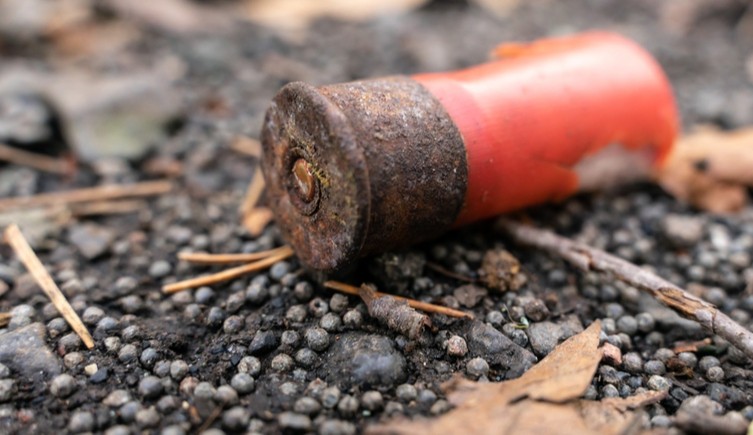
It’s been a sobering couple of weeks for die-hard shooters still refusing to abide by the BASC plea for a voluntary shift away from lead shot to more environmentally sound alternatives. We’re somewhere in the middle of a 5-year transitionary period during which members of the shooting community are being encouraged to use up their existing supplies of lead ammunition and switch to non-lead going forward. A lot of hard work has been done by many individual and groups to even get to this stage. (You can read about that here if you’re interested in the history:
You may well be scratching your head that anyone in their right mind would be resistant to moving away from lead use. Not only is this toxic substance still being blasted into the environment decades after it was banned elsewhere, but the animals killed by it are being consumed by both humans and wildlife. As a poison, it’s been banned in UK household pipes since as long ago as 1970, in angling in 1986, paint in 1992 and petrol in 2000. The Food Standards Agency has strict limits in place when it comes to acceptable trace levels of lead in meats like pork and chicken yet “game” meat is, for reasons that are not clear, still exempt from these restrictions.
Either through ignorance of the dangers, or convinced their personal wishes should always be allowed to trump science, many in the shooting community have continued to ignore the dangers posed by lead. The cosy relationship between bodies such as the BASC, the National Gamekeepers Association, National Farmers Union and factions of the Countryside Alliance with Defra and Natural England has no doubt helped enormously. Until now.
On 29th April 2022 the UK Health & Safety Executive (HSE) received a request from the Defra Secretary of State, with the consent of the Scottish and Welsh Governments, to prepare a restriction document assessing the risks to the environment and human health from lead in ammunition.
In the European Union a restriction was been adopted for lead in gunshot over wetlands back in January 2021 and a wider restriction for lead in shot, bullets and fishing weights is in progress. The dossier prepared by HSE examines whether a similar restriction should be introduced into England, Scotland and Wales covering lead in ammunition in all habitats. The HSE conclusion seems to be that it should.
Matt Cross, writing in The Shooting Times two weeks ago cited the HSE as saying: “An unacceptable risk has been identified for both hunting with lead shot and from sports shooting. There are no realistic ways to limit the amount of lead entering the environment or to eliminate the risk to humans from ingestion of lead when lead shot is used for hunting”. The widely held view is that the use of all lead ammunition for live animal shooting, and for the majority of forms of target shooting, will be banned. But when?
The HSE proposals are for an 18 month or 5 year transition period between the introduction of new rules and a ban coming into force depending on the calibre of weapon in use. Wait. Didn’t I say earlier that we were already half way through a 5-year transition period? I did. But a voluntary one. And one which is not going well or being taken especially seriously by large factions of the BASC membership.
The HSE proposals will lead to legislation banning the use of lead ammunition after an 18 month period in the case of large calibre rifle ammunition and after a 5 year period for airgun and small calibre rifle ammunition. The longer transition period for smaller rounds is intended to give enough time for non-lead alternatives to be developed. What’s that? Hasn’t the sector already had decades to prepare for this day arriving? Well, yes. But, you know, inertia, apathy, self-entitlement, arrogance and all that…
The situation for shotgun ammunition is more uncertain. The HSE dossier proposes a ‘derogation’ that could allow the continued use of lead ammunition at shooting sites where systems can be introduced to recover at least 90% of the lead shot fired. If this “derogation” is agreed then the sale and use of lead ammunition could continue for the maximum 5 year period while these systems are put in place. If the derogation is not agreed the transition period would last just 18 months before a ban came into force.
As you might expect, the BASC, despite its public support of a 5 year voluntary period from 2020 to 2025 to end lead use, hasn’t taken too kindly to the news that there will now be a mandatory ban. Frankly, I don’t understand why if it seriously believed its members would have given up lead by 2025 anyway. Responding to the HSE proposals, BASC Executive Director of Operations Steve Bloomfield said: “We have significant concerns about the short timeframes outlined in the dossier for transition away from the use of lead ammunition, which could be as little as 18 months. We will fight for timelines that are realistic and guided by the sector to endure that the range of lead-free products and their supply can meet market demands. BASC will be engaging with the regulator to ensure that proposals are robustly scrutinised and that any future restrictions are based on evidence and proportionate to identified risks. We will not accept disproportionate restrictions that unfairly disadvantage shooting activities”.
The BASC now has a tricky balancing act on its hands. Bloomfield volunteered: “Given the severity of the proposed restrictions, the voluntary transition has afforded the sector a head-start in the move away from lead ammunition”. Which seems at odds with “fighting for timelines that are realistic and guided by the sector” doesn’t it? To be clear, the HSE proposal includes a 6-month public consultation period which ends on 6th November 2022. Realistically the earliest date an 18-month mandatory period might end would be mid-2024 and early 2025 feels more likely. Which is the year in which the BASC voluntary transition was due to end anyway.
By hook or by crook it appears that lead use for most forms of shooting will be dead by or in 2025 and for the remainder by or in 2028. A blow for self-regulation. Or an acceptance that self-regulation is a smoke and mirrors trick on which the authorities feel obliged to bring down the curtain.
I’ll leave you with a couple of quotes which made me raise an eyebrow. The first is from a “Scottish shooter” called Alan Urqhart who is quoted as having asked: “Would we even be in this position if the shotgun organisations hadn’t introduced their own voluntary ban?” (Yes, Alan. Because lead is poisonous and continued use of it in the countryside and food chain is unacceptable). Alan went on to say: “Maybe if they had made it clear they would fight, the HSE might not have gone after lead at all”. (Oh, Alan. Is there any spare room under your duvet of incomprehension?).
And, finally, we have “air rifle shooter” Reece Hesketh who is quoted as asking: “If they go 5 years and no-one can produce a non-lead pellet at a sensible price, then what?” I’d go with;
(a) Ask them what they’ve been doing for the past 30-40 years and/or
(b) Pay the price you have to pay and regard it as the premium cost of inertia and/or
(c) Stop shooting.
I look forward to seeing the results of the HSE consultation process and details of the roll-out of a legislative ban on lead in all ammunition in the shooting sector. And to seeing the Food Standards Agency introduce the same lead toxicity restrictions in all forms of game meat as they do for other animal produce entering the human food chain.

 ecolelogical