
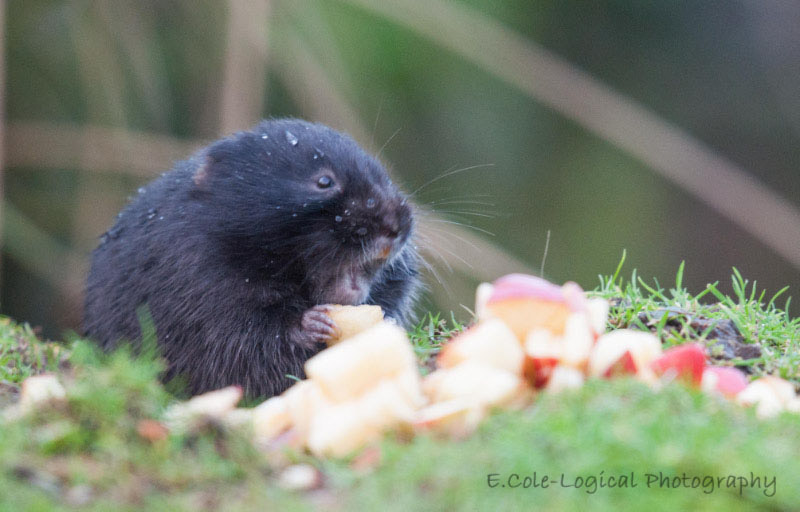
I used to be a keen coarse fisherman and could be regularly found lakeside or on a river bank staring hopefully at the tip of a float or the end of a rod. Although it’s close to a decade since I did any serious fishing, and it isn’t something I’ll return to, I would occasionally be treated to seeing a water vole swimming or foraging in the early morning or at dusk. Such delights broke up the monotony of not catching anything and were joyous moments.
These days I tend to be lugging a camera rather than a ton of fishing equipment but I’m still regularly at the side of a canal, river or lake. It was only recently that I realised I never see water voles anymore – not in Surrey at least – and now I know why.
I’m a member of Surrey Wildlife Trust (SWT) because it’s one small way in which I try and make a difference. I found out that the Trusts’ ‘Surrey Water Vole Recovery Project’ has trained volunteers in recent years to carry out studies, searching for signs of water voles in the county. Despite around 100 surveys being conducted since 2015 across six different river catchments in Surrey not a single water vole was found. Devastatingly, Surrey Wildlife Trust now regards this little mammal to be “functionally extinct” in the county. A horrific term and prospect.
In fact water voles are one of the fastest declining mammals nationwide. A study of data collected by The Wildlife Trusts over a 10 year period (“The National Water Vole Database and Mapping Project”) revealed that water vole distribution has crashed by nearly a third across England and Wales. The data covered a period from 1st January 2006 to 31st December 2015 and found a 30 per cent drop in places where water voles had been historically found.
The main reason for their decline has been the widespread destruction of wetland habitats as well as the success of non-native American mink, which predate on them. It’s a long time since I’ve seen a mink on my wanderings and hopefully that’s a positive sign for the future of water voles in the UK and Surrey especially. They (the voles, although possibly also the mink!) can still be found in neighbouring counties like Sussex and the last wild one I saw was on the river in Arundel about 7 years ago. There are also populations in Hampshire, Kent and even London, although in no small part their preservation is due to the success of reintroduction programmes and conservation work.
Along with the other Wildlife Trusts, Surrey is making concerted efforts to bring water voles back by working with volunteers as part of its “RiverSearch” citizen science project to restore and conserve the riverbank habitats in which they burrow and feed. It also advises landowners on river and ditch management to benefit them. Long may this important work continue.
For now, it seems the only chance you have of seeing a water vole in Surrey is a visit to the British Wildlife Centre in Lingfield (https://britishwildlifecentre.co.uk/). It’s a wonderful place to visit and see many of our indigenous species. On my last trip there in 2018 I was fortunate enough to be able to capture the photograph above when the subject eventually emerged into the open late in the afternoon. One day soon I sincerely hope I can see these little creatures back in more natural surroundings in the wild.
To help water voles and other wildlife, why not sign up as a volunteer with your local Trust, become a member or make a donation? If you’re in Surrey you can get all the information you need here; https://www.surreywildlifetrust.org/
(If you happen to see a water voles in Surrey please report any sightings to the Surrey Biodiversity Information centre on 01483 795448 or by email to surreybic@surreywt.org.uk. They will, I’m certain, be very happy to hear from you).

 ecolelogical