
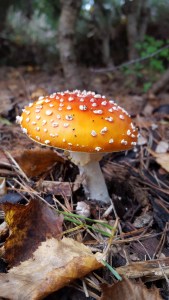
Back in the Autumn we were wandering through some woodland and came across this little fungus. I loved the colours so took a photo and forgot about it until recently when I decided to try and find out what it was. Sad, right?
Here’s what I discovered. It’s a fungus called fly agaric (amanita muscaria for you swots out there), a little toadstool that is under no particular conservation threat and quite widely spread. Well, so what? Read on, for it is in the quest for knowledge that interesting discoveries can be found.
This little fungus has a long history of use in religion, especially in Asia, where it has been used in a sacred and hallucinogenic ritual drink in India and Iran for more than 4,000 years. Its even the subject of a religious Hindu hymn.
Fly agaric is the toadstool that appears in all manner of fairy tales and is the “mushroom” sampled by Alice in Lewis Carroll’s seminal work “Alice’s Adventures in Wonderland”. (Incidentally, I hadn’t realised that he wrote this novel as long ago as 1865 or that his real name was Charles Lutwidge Dodgson!).
Although there are few records of human death resulting from eating it fly agaric is poisonous and renowned for having pyschoactive and hallucinogenic properties. As a result it’s classed as inedible despite being used historically in various medicines and as an early form of insecticide. Broken up and sprinkled into saucers of milk the toadstool releases something called ibotenic acid which both attracts and kills flies. Apparently.
Here’s my favourite fly agaric fact though. This little toadstool was commonly found on Christmas cards in Victorian and Edwardian times as a symbol of good luck and its colours are thought to have been the inspiration for Santa Claus’s red and white outfit. I much prefer that idea to the horrific theory that Santa wears red and white because Coca Cola stole Christmas as a marketing gimmick.
[Credits: Photograph by yours truly. Fly agaric information courtesy of the Woodland Trust. http://www.woodlandtrust.org.uk]

 ecolelogical